


05
Oct 2026
Blog
ODM vs. OEM for Life Science Instruments: A Buyer's Guide
A gap in your instrument range. A missing piece in your reagent business. A technical capability that hasn't become a product yet. Where you start determines what kind of partner you need.
ODM and OEM are often used interchangeably. The distinction matters less than the work you need done: is there an instrument to manufacture already, or does someone still need to design it?
At Arise Biotech, we've worked with life science brands on both sides of that question since 2002 — across 22+ instrument development projects, with long-running partnerships that continue through production. Some came to us with an instrument design. Others came with a product gap, a workflow that existing instruments couldn't support, or a technical problem they hadn't yet turned into a product.
What do ODM and OEM mean in practice?
- ODM (Original Design Manufacturing) includes instrument development. You bring the application and product requirements; your partner designs the instrument, whether that means building a new system or adapting an existing technical platform.
- OEM (Original Equipment Manufacturing) starts with a design or platform that already exists. You might need a partner to manufacture an instrument you designed, or you might offer an established instrument under your own brand. Some adaptation is often still involved.
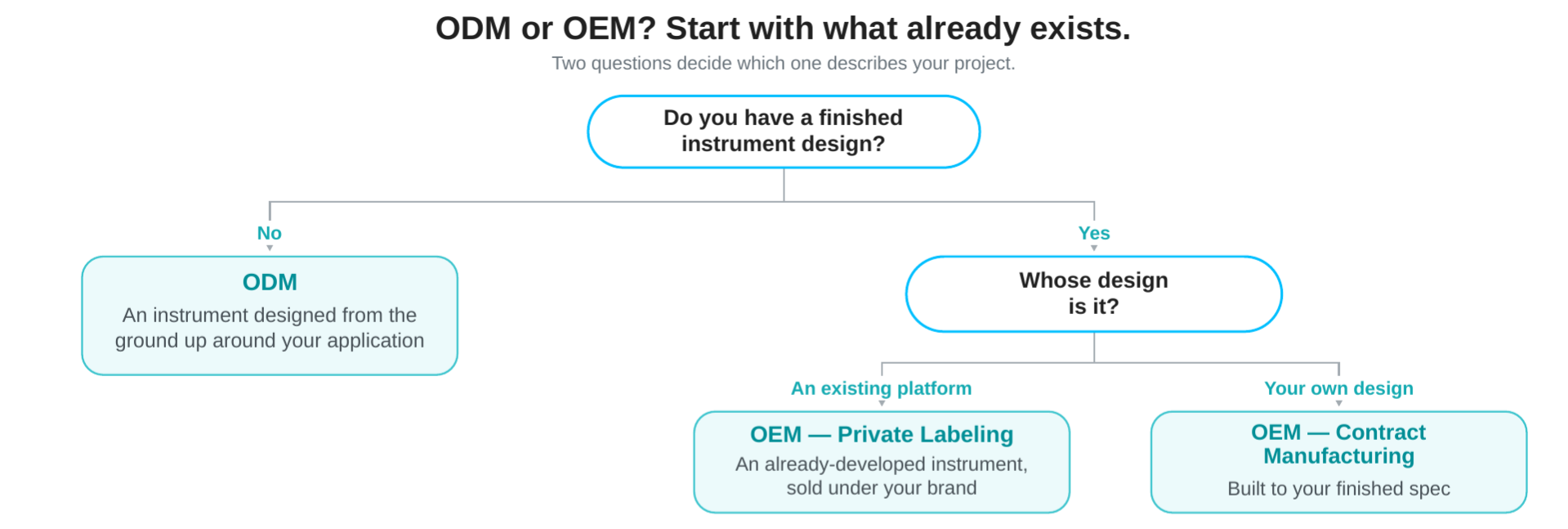
Before deciding which applies, pin down what already exists, what needs to change, and who will own the development work.
Which situation sounds like yours?
1. You need to fill a gap in your instrument range
Your customers are asking for a PCR/qPCR system, a refrigerated centrifuge, or an automated sealer. You can see the market, but assigning your core R&D team to another product line would slow the work they're already doing.
If an existing platform meets the requirements, private labeling may be the quickest way to fill that gap. If the instrument needs different performance, controls, or workflow integration, an ODM project gives you room to build around those needs. Arise has developed thermal cyclers, refrigerated microcentrifuges, and heat sealers for international partners — which gives the first technical conversation somewhere concrete to start: which requirements are familiar, and which ones will demand new engineering.
2. You sell reagents or consumables, but the instrument is missing
A reagent or consumable is easier to adopt when customers have an instrument that works naturally with it. It can also turn a collection of products into a more complete offering under your brand.
Sometimes an established instrument is enough. In other cases, a generic platform gets almost everything right but misses the detail that matters: the shape of a pipette tip, the dimensions of a plate, a dispensing step, or the way a user moves through the assay. This is precisely the kind of problem our pipetting and sealing work is built around — designing the instrument and the consumable as one system, not two separate products that happen to share a logo.
3. If you already have a finished design
Some conversations start here too — a completed instrument that just needs a manufacturing partner. It's a narrower scope than the projects above, and worth a quick conversation to see whether it's the right fit before going further.
4. You have a technical challenge, not yet a product specification
Perhaps optical detection needs to work alongside precise thermal control. Perhaps a liquid-handling step needs to fit into an existing workflow. You know what the application needs to achieve, but not yet what the finished instrument should look like.
That's a reasonable place to begin an ODM conversation. A compact team that brings mechanical, electronic, optical, and software thinking into the same discussion can help test the idea, identify the trade-offs, and define a product worth building.
What should you look for in a partner?
1. Relevant work, not just a long capability list.
Ask which instruments the team has developed, what it was responsible for, and whether that experience relates to your application. It's also worth asking whether they've had to solve a problem the standard approach in your field couldn't — that's a better signal of depth than a capability list.
2. A clear path from design decisions to production.
At Arise, every unit goes through final verification and calibration before shipment. Product testing may also include burn-in, EMI/EMC, environmental, and endurance tests, depending on the instrument. Ask any potential partner how they test a design and check each unit — the answer tells you whether quality is built into production or just claimed in a proposal.
3. A team that can work through the awkward details.
Instruments rarely fit neatly into one engineering discipline. The question is how quickly the people responsible for mechanics, electronics, and software can resolve a problem together, then carry that decision into the next build. At Arise, roughly a third of the team is dedicated R&D, working side by side rather than in sequence — the kind of setup that tends to answer a design question in days, not weeks.
4. A place to keep making the product.
Arise develops and manufactures in Taiwan, close to a deep electronics and precision-engineering supply chain. That proximity matters when a component changes, a design needs another iteration, or production has to continue for years. Our ISO 13485-certified quality system provides the structure for traceability and consistent manufacturing; our compact team means the person who designed your instrument is often the same person who answers when something needs to change.
The point of an ODM or OEM partnership isn't only to reach the first shipment. Long-running products need people who keep paying attention after launch.
FAQ
How long does it take to develop an ODM instrument?
It depends on how much already exists. Adapting a proven platform is different from developing a new instrument or bringing several technologies together for the first time. Bring your intended application, key performance requirements, and target launch window to the first discussion — that gives the team a basis for defining the work and a realistic schedule.
Do we need to share our full product roadmap or proprietary design at the first meeting?
No. We can begin with the application, the problem you want to solve, and the broad technical and commercial requirements. Detailed specifications can follow once the potential scope and confidentiality arrangements are clear.
Can Arise support production after launch?
Yes. Instrument programs can continue well beyond the first production run — depending on the agreement, that may include recurring manufacturing, component sourcing, quality checks, and agreed changes as the product stays on the market.
Start with what you're trying to build
A gap in your product range, an instrument for your consumables, and a finished design awaiting production call for different kinds of help. Tell us what you have today and what the instrument needs to do for your customers. That's a better first conversation than trying to settle on an ODM or OEM label before the work is clear.